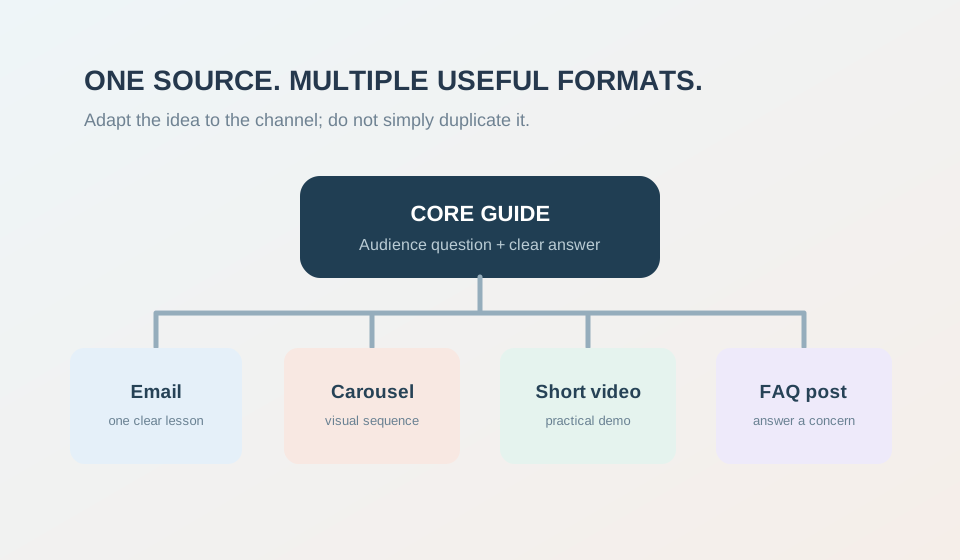
Repurposing is not reposting identical text everywhere. Start with one well-researched answer, then adapt its most useful parts to the question, format and expectations of each channel.
Choose a source worth expanding
Imagine a company has a genuinely useful guide called “Five questions to ask before booking a home energy assessment.” The guide defines the service, explains what information to prepare and outlines questions to ask a provider.
Instead of producing five unrelated posts, build a small set of focused pieces from that source. Check that the original information is accurate, current and appropriate for the audience before republishing it elsewhere.
If the source article lacks a clear answer or relies on unsupported claims, improve the source before turning it into more formats.
Map the same idea to different needs
| Format | Audience need | Angle |
|---|---|---|
| Website article | Full explanation | Five questions, with detail and caveats |
| Decide whether to act | The one question people often overlook | |
| Social carousel | Quick practical overview | Five slides, one question each |
| Short video | See the process | Show how to prepare information |
| FAQ post | Resolve a specific concern | What happens before the visit? |
The links and calls to action should follow the reader’s context. A short social post can refer back to the full article; an email can invite a reader to compare options without forcing a sales pitch.
Use a manageable seven-day production rhythm
| Day | Task | Output |
|---|---|---|
| Monday | Check the facts and improve the source | Updated guide |
| Tuesday | Extract the clearest learning points | Five-slide storyboard |
| Wednesday | Write a focused email | One useful email draft |
| Thursday | Record one short demonstration | Video or illustrated sequence |
| Friday | Answer an objection or common question | FAQ post |
| Weekend | Observe genuine audience feedback | Questions for next week |
If the team is small, stretch the workflow over two or three weeks. Consistency comes from a repeatable process, not from publishing every day regardless of quality.
Build review and improvement into the cycle
Review the material for accuracy, accessibility, readability and the suitability of each channel. Check whether the reader can understand a carousel without an accompanying caption, and whether a video has captions or a usable text alternative.
Measure meaningful responses: what questions arrived, which guides people returned to and whether enquiries were appropriate. Treat likes and impressions as supporting signals, not the entire outcome. The content calendar guide explains how to sustain the rhythm.
If audiences repeatedly ask about cost, add a transparent “what affects the price” section to the source guide, then create a focused FAQ answer. Improve the original asset before multiplying the message.
Before you move on
- One complete, accurate source to build from
- A distinct purpose for each format
- A realistic production and approval schedule
- Clear links back to the deeper resource where useful
- A review process based on real audience questions
Choose an existing article that already answers a real customer question, then adapt one section into two new formats.