A brief is not a formality. It gives a designer, writer, agency or freelancer the context needed to make sensible choices—and makes approvals clearer for the business commissioning the work.
Describe the outcome, not just the task
“We need social media management” names an activity, not an outcome. A stronger brief explains the business problem and the kind of improvement the work should support.
Please suggest a social media package.
No audience, measurement or timing.We want a three-month content plan answering common pre-sale questions, with a monthly review of enquiries and engagement.
Scope and success can now be discussed.Do not invent precise numeric targets if there is no baseline. State what is known and identify the information the specialist should help establish.
Include the seven decisions that shape the work
- Business context: What is sold, to whom, in which market and why customers choose it.
- Primary outcome: One result that matters more than the others.
- Audience: Questions, objections, needs and decision stage.
- Scope: Channels, deliverables, formats and what is explicitly excluded.
- Budget and timing: State whether ad spend, production and fees share the same budget.
- Measurement: How results will be evaluated and by whom.
- Ownership: Who provides material, reviews drafts and approves changes.
Practical constraints such as brand access, legal review and content permissions deserve a place in the brief. They are easier to resolve before production begins.
Use a one-page working template
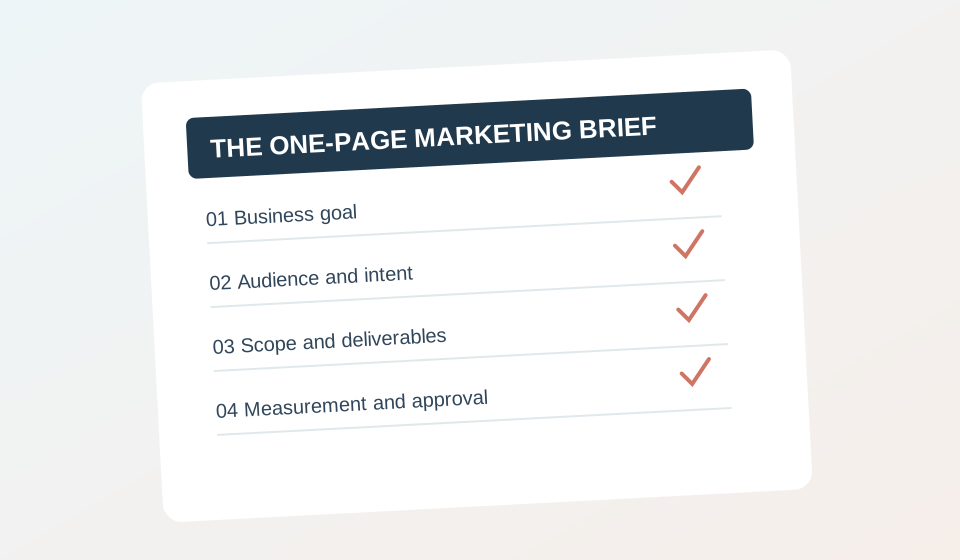
This example is a starting point, not a mandatory procurement form. You can copy the structure into a document or download the text file below and fill in the blank fields.
The downloadable file is plain text so it opens easily in an editor or word processor. It contains empty fields rather than fabricated company information.
Agree how feedback and handover will work
Specify one point of contact and a realistic review window. Decide which feedback is required for launch and which suggestions can be logged for a later phase. Ask the supplier to state assumptions and open questions rather than silently filling gaps.
| Item | Client | Specialist |
|---|---|---|
| Offer and eligibility | Confirm accuracy | Translate into clear copy |
| Visual assets | Provide rights and brand material | Prepare suitable layouts |
| Tracking | Define a qualified lead | Implement and test measurements |
| Approval | Give consolidated feedback | Explain trade-offs and revise |
When performance depends on both ads and website improvements, use the landing-page checklist to describe the on-site requirements and the KPI worksheet to agree on reporting.
Before you move on
- Clear business context and a single priority
- Audience, offer and exclusions explicitly described
- Deliverables and budget boundaries agreed
- Measurement method and baseline noted
- A named person responsible for approvals
Download the template, complete only what you already know and flag the unknowns as questions for the first meeting.