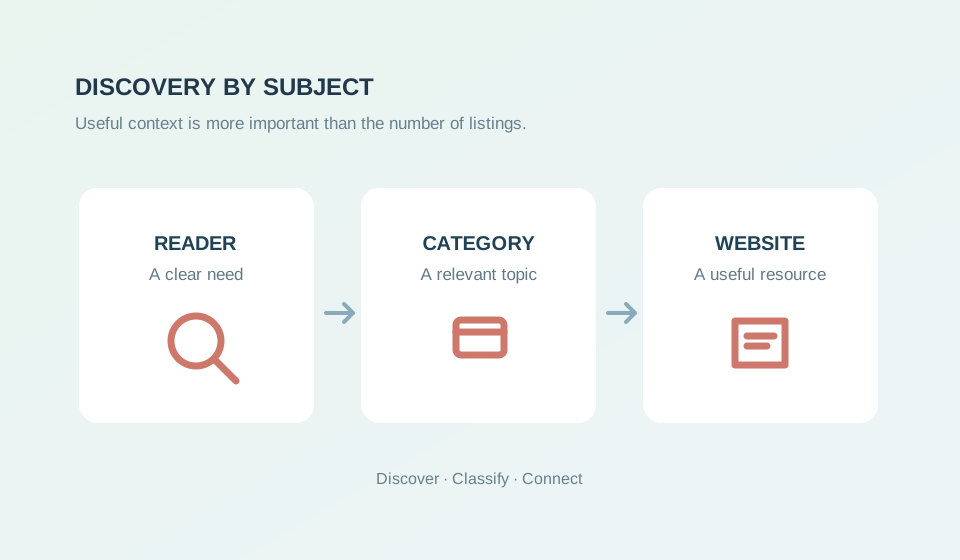
Directories helped people discover the early web. Today, their value depends on subject relevance, editorial care and whether a listing is useful to a real visitor—not on submission volume.
Why web directories mattered
Before search engines became the default route to online information, finding useful websites often meant exploring topic-by-topic collections. A directory grouped resources under subjects—technology, travel, business or education—and allowed readers to move from a broad category to a narrower one.
Many early directories relied on editorial review. Human editors selected categories, checked submissions and wrote short descriptions that explained what a website was about. The best examples were not simply lists of URLs: their organization helped people understand where a resource belonged.
That model is still visible in a volunteer-edited directory that continues the subject-based approach associated with the original Open Directory Project. Browsing by category makes the underlying editorial principle easy to see: a useful listing is one that fits the topic and helps somebody discover relevant information.
From discovery to off-page SEO
As search engines began using links to understand relationships between pages, directory submissions took on a second purpose. Website owners hoped listings would provide inbound links as well as visitors. For a time, submitting the same site to large numbers of directories became a common promotional tactic.
The problem was not the directory format itself. It was the loss of editorial purpose. Automated submissions, vague descriptions and categories full of unrelated websites turned many collections into low-value pages.
A legitimate directory listing makes sense because someone might use that directory to find the website. A submission made solely to manufacture a backlink has a very different purpose.
Today's off-page SEO is better understood as earning and maintaining relevant references across the wider web. Directory listings can be part of that picture, but they should not be mistaken for a substitute for useful content, genuine reputation and appropriate editorial mentions.
The role of smaller and regional indexes
Not every discovery resource needs to address the whole internet. A focused directory can make a smaller promise: helping visitors explore websites connected to a language, market or subject. For a reader looking specifically for Greek-language resources, a local Web Directory illustrates how websites can be collected under recognizable themes, from business and technology to personal sites and other interests.
Such an index may be useful because of its audience and organization, not because it is large. A topic-specific listing can provide context; a regional listing can help people browse resources they might otherwise miss.
That does not automatically make every listing valuable. Categories need to remain navigable, information needs to be accurate and visitors should be able to recognize why a particular website appears where it does.
How to judge a directory before submitting
Rather than counting potential backlinks, assess the directory as a visitor would. Open the category where the website would appear and ask whether the surrounding listings help establish a meaningful subject.
| Check | Question to ask | Positive signal |
|---|---|---|
| Category fit | Does the website belong in this subject? | Nearby listings address similar interests |
| Editorial approach | Are entries reviewed and described? | Useful, specific descriptions rather than keyword lists |
| Visitor experience | Can a reader browse and find something worthwhile? | Clear navigation, working links and readable pages |
| Accuracy | Can information be corrected if it changes? | Current titles, relevant categories and maintained entries |
| Reason for inclusion | Would the listing still make sense without ranking benefits? | A credible path for relevant visitors to discover the site |
A small, well-maintained specialist directory may be more suitable than a much larger general directory with little relevance to the audience. Avoid treating unverified authority scores or promises of instant rankings as substitutes for the checks above.
Putting directories in perspective
A balanced off-page strategy might include credible editorial coverage, useful industry resources, professional associations, relevant business references and, where appropriate, a limited number of directory listings. The aim is not to recreate the submission campaigns of the early 2000s, but to build connections that a real reader can understand.
Start by knowing the website's audience and subject. Choose external placements that fit. Use an accurate title and description, then revisit the information when services, categories or URLs change. Record referral traffic and the quality of visits where you can, without assuming that every external link will generate measurable search benefits.
The same idea applies internally: a resource becomes more useful when readers can move naturally between related subjects. Our SEO content audit guide covers the internal side of that work, while the search optimization overview puts both content and external visibility into a broader strategy.
Before considering a listing
- Confirm there is a genuinely relevant category.
- Check whether existing entries help visitors discover useful resources.
- Use an accurate title and a natural, informative description.
- Do not submit the same website indiscriminately to unrelated directories.
- Review listing information when the site changes.
Use directories as a way to help people find relevant websites—not as a shortcut for accumulating links.